A doer creates what a watcher consumes. We all are both at various
times of any day, but one could argue that, in a specific context, most people
are primarily one or the other. Since there are a lot more television watchers
than actors, the presumption is there are a lot more watchers in that
context.
Are your students doers, or watchers?
This question is a great deal different from the previous
one, influenced by what we might infer from the word "student." Here's what Dictionary.com says
about that word:
stu-dent. [stood-nt, styood-] - noun
- a person formally engaged in learning, esp. one enrolled in a school or college; pupil: a student at Yale.
- any person who studies, investigates, or examines thoughtfully: a student of human nature.

That’s actually different than one might guess, since most people (even many teachers) presume that a teacher is the doer, and students watch. That’s the traditional “lecture” instructional paradigm. But current research on learning indicates that knowledge is constructed by a student, rather than induced by a teacher. Research in effective technology use and integration into instruction goes further, pointing to
 student-directed work in knowledge construction, especially in the case of higher-order learning:
"depth of knowledge 4," or "synthesis" or “evaluation” from Bloom's Taxonomy
(see LoTi, ACOT2).
student-directed work in knowledge construction, especially in the case of higher-order learning:
"depth of knowledge 4," or "synthesis" or “evaluation” from Bloom's Taxonomy
(see LoTi, ACOT2).From this perspective, the act of teaching is the act of providing the tools, materials and environment whereby students can successfully engage, interactively participate in, and direct the learning process.
So, we're back to the question.
Are your students doers, or watchers?
...and the answer should be that, if they're truly students, they must be doers. That isn't to say that watching must never happen in the classroom, but if it does, it should be aimed at lower-order goals, or as a preparation for doing.
Are your educational technology purchase decisions aimed at doing, or watching?
Every education technology purchase carries with it an
implied pedagogy, and sorting that out has never become more complicated than in
the digital age. Fifty years ago, when television first became one of the
available technologies for the classroom, the implied pedagogy was “watching,”
and many teachers were upset that we'd be turning an entire generation of
students into passive consumers. But no consistent and measurable negative
impact was ever found. One might speculate that, since the primary instructional
paradigm at the time was lecture, TV just replaced one "watching" context with
another. The “TV in the classroom” controversy simply ran out of steam.
But that's quite different from today. Students
at MIT -- one of the best universities in the country (and, not incidentally,
one of the most digital) -- spend, on average, over 50 hours a week engaged in
digital media (see Digital Nation, a PBS FrontLine special). This media is
interactive: email, Skype, Facebook, texting, Twitter, etc. Clearly, when such
students are left to their own devices (pun intended), they are usually doers.
So when we try to work out how best to allocate limited educational resources
and tech purchase budgets, we’re not doing it in the same context as the
teachers of 50 years ago. The selection of education technologies today is
taking place against a backdrop of interactive "doing" by almost every young
person, as soon as their school day ends. The expectation for engagement, and
the social and intellectual presence of a student in such engagement, makes the
selection of any classroom technology very different from fifty years ago. We're
no longer competing with the lecture, we're competing with Facebook.
We’ll now look at the underlying implication for "watching" vs.
"doing" for several popular categories of instructional technology, to see what
they’re implied pedagogy actually is.
Classroom Response Systems.
Classroom Response Systems.
"Clickers" are all the rage. They make assessment fun. They
give instant feedback, which can provide direction to instruction. They are very
engaging for students (at least for now, while they're still new).
For our discussion, they're a really great metaphor for making succinct what we mean by students' "doing" the business of learning. Assessments, whether delivered by paper or classroom response systems, do ask students to do something. But it is impossible to avoid the implications of response systems -- students do not inherently build knowledge interactively through any assessment tool. They do not control the process, and usually interact with the content in a teacher-directed manner.
For our discussion, they're a really great metaphor for making succinct what we mean by students' "doing" the business of learning. Assessments, whether delivered by paper or classroom response systems, do ask students to do something. But it is impossible to avoid the implications of response systems -- students do not inherently build knowledge interactively through any assessment tool. They do not control the process, and usually interact with the content in a teacher-directed manner.
"Smart" Classroom Tools
These tools are associated with digital projection systems and interactive whiteboards, as well as hand-held devices such as the Smart Slate. These systems differ a great deal from classroom response systems in that their effectiveness is in direct student manipulation. Like classroom response systems, these tools can be very effective in producing engaging and interactive activities for students in a classroom setting.
However, once again, all students in the class will usually be doing the same thing. As a matter of fact, even when students are interacting directly with the technology, the number doing so will be small (usually one, often zero when a teacher uses it exclusively as a presentation tool), and all others will be truly watching.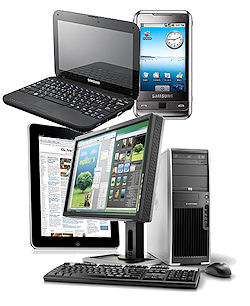
These tools are associated with digital projection systems and interactive whiteboards, as well as hand-held devices such as the Smart Slate. These systems differ a great deal from classroom response systems in that their effectiveness is in direct student manipulation. Like classroom response systems, these tools can be very effective in producing engaging and interactive activities for students in a classroom setting.
However, once again, all students in the class will usually be doing the same thing. As a matter of fact, even when students are interacting directly with the technology, the number doing so will be small (usually one, often zero when a teacher uses it exclusively as a presentation tool), and all others will be truly watching.
Before you conclude that I am against such technologies, let
me qualify. As any student of Norman Webb and Benjamin Bloom will tell you,
there are important learning goals associated with each of the levels they
describe, even the lowest ones, with activities (some of which are just
watching) appropriate for each. In addition, a great teacher can very
effectively use any tool to encourage a wide array of instructional approaches,
just as they can turn an ordinary chalkboard into a student-driven knowledge
construction tool. But in current instructional practice, higher-order thinking
and learning are usually the neglected goals. Not incidentally, they’re also the
ones which benefit the most from student-directed, socially engaging learning
activities. So we need to make sure that we deliberately provide technologies
which inherintly support these higher goals (and, not incidentally, reflect the
practices students are using outside of school). The implied pedagogy of the
above tools means that they will not, in themselves, satisfy the needs and goals
of higher order learning goals.
In the 21st Century, where information and
interactivity is delivered in large part over digital networks, that usually
means an individual computing device. There are dozens of ways a classroom can
provide such devices to students: PDAs/iPods, iPads and eReaders,
netbooks/laptops, classroom workstations/terminals, even smart phones. All have
advantages and disadvantages (a topic for a future blog entry).
So when you map out how your classroom, your school, or your district
supports and purchases technologies, ask yourself…
Are at least some your educational technology purchase decisions
aimed at "doing?"
